
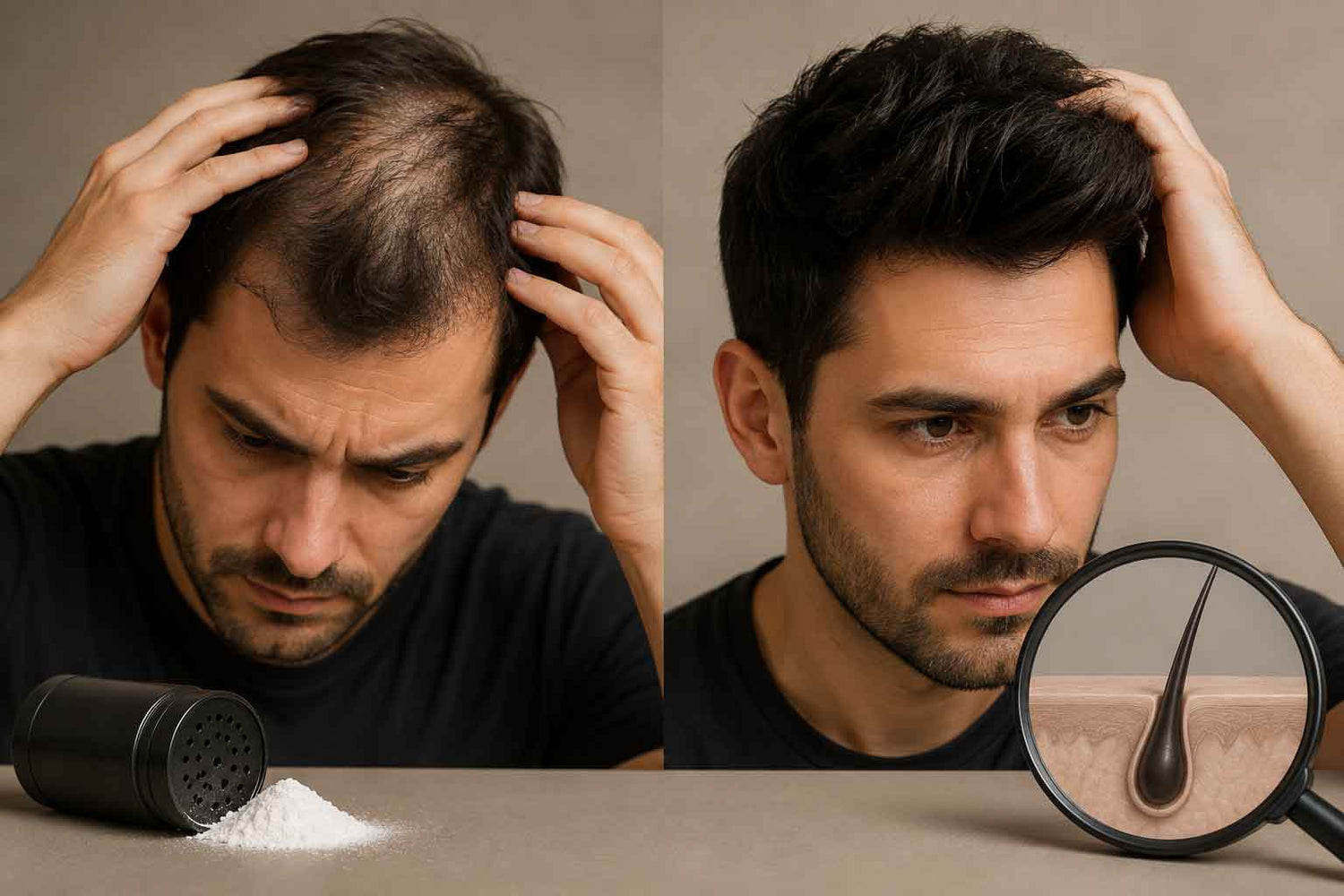
Short answer: No, texture powder does not directly cause permanent hair loss or androgenetic (pattern) baldness. There is no clinical evidence that ingredients like silica, corn starch, or mica attack the hair follicle. What texture powder can do, especially with heavy or frequent use and poor scalp hygiene, is contribute to buildup, dryness, and scalp irritation — and in people who are already prone to shedding or breakage, that irritation can make hair loss more noticeable. The powder isn't the root cause; it's sometimes a contributing stressor layered on top of an existing vulnerability.
If you've noticed more hair in the shower drain since you started using a styling powder, it's a fair thing to investigate. But the investigation usually leads somewhere other than the powder itself: genetics, hormones, an underlying scalp condition, or simply too much product left on the scalp for too long.
This article walks through how texture powder actually works, what dermatology research says about the ingredients involved, the real mechanisms that connect styling products to shedding, and how to tell whether your powder is the problem or just an innocent bystander.
What Texture Powder Actually Is
Texture powder (also called volumizing powder, hair styling powder, or root powder) is a lightweight, water-free styling product applied at the roots or through the mid-lengths of the hair. Unlike gels, pomades, or waxes, it works by mechanical friction and oil absorption rather than by coating the hair in a film.
Most formulas share a common ingredient backbone:
- Silica – an ultra-fine mineral powder that absorbs sebum and creates friction between strands, which is what makes flat hair feel gripped and "lifted" at the root.
- Corn starch or rice starch – natural absorbents that soak up oil and add matte texture.
- Mica – a mineral that can add subtle texture and sometimes a soft, non-shiny finish.
- Clay (in some formulas) – kaolin or bentonite, used for extra oil absorption and grip.
None of these are penetrating ingredients. They sit on the surface of the hair shaft and scalp; they aren't designed to enter the follicle or interact with the hair root. That distinction matters, because most causes of real hair loss originate at or below the follicle, not on the surface of the strand.
What Actually Causes Hair Loss
Before pinning anything on a styling product, it helps to know what dermatologists actually look for when someone reports shedding. The overwhelming majority of hair loss falls into a small number of categories, and topical styling powder isn't a standard entry on that list.
Androgenetic alopecia (pattern hair loss). This is genetic and hormonally driven, tied to the hair follicle's sensitivity to DHT (dihydrotestosterone). It shows up as a receding hairline or thinning crown in men and diffuse thinning at the part line in women. It has nothing to do with styling products.
Telogen effluvium. This is the most common reason people suddenly notice "more hair than usual" falling out. It's a temporary, diffuse shedding pattern triggered by a physiological stressor — illness, surgery, crash dieting, childbirth, major stress, or a nutrient deficiency — that pushes an unusually large share of hair follicles into the resting (telogen) phase at once. According to a clinical review published through the National Institutes of Health, telogen effluvium is a reactive process where a metabolic or hormonal shock shifts follicles out of their normal growth cycle, and shedding becomes visible roughly two to three months after the trigger. The National Institutes of Health also notes that up to 15% of scalp hair is normally in the resting phase at any given time, and effluvium happens when that share spikes.
Scalp inflammation. This is the one legitimate mechanism connecting styling products, including texture powder, to increased shedding. Persistent irritation — from an allergic reaction, a clogged follicle, or a harsh ingredient — can, in some cases, push follicles prematurely into that same resting phase. A UK pharmacy guide reviewing dermatology literature on this topic states plainly that robust clinical data directly linking texture powders to hair loss are lacking, and that most concerns are theoretical or based on more general evidence about contact reactions and scalp inflammation.
Nutritional and medical factors. Iron deficiency, thyroid disorders, certain medications, and postpartum hormone shifts are all well-documented, common causes of diffuse shedding that have nothing to do with what's applied to the hair.
Put together, this means that if you're shedding more than usual, a styling powder is a reasonable thing to rule out, but it sits near the bottom of the list of likely culprits, not the top.
Where the Texture Powder Concern Actually Comes From
The worry isn't baseless. It comes from three real, documented mechanisms, none of which amount to the powder "causing" hair loss on their own.
1. Product buildup and clogged follicles
Texture powder is designed to grip and absorb, which means it's also designed to stay put. Used daily without proper washing, it can accumulate at the scalp. That buildup, combined with natural sebum, can sit over the follicle opening. It won't kill a follicle, but a chronically clogged, irritated follicle environment is not a healthy one, and dermatology research on chronic scalp inflammation shows that ongoing irritation can disrupt the normal hair growth cycle. That disruption is the same telogen-effluvium-style shedding described above, just with a topical rather than systemic trigger.
2. Dryness and shaft breakage (not true "hair loss")
Because texture hair powder works by absorbing oil, overuse can strip natural moisture from the hair shaft and scalp over time. Dry, brittle hair snaps more easily, especially during brushing or heat styling. This shows up as thinner-looking hair and more strands on your brush, but it's breakage along the shaft, not loss from the root. It's a cosmetically similar problem with a very different mechanism, and it responds to moisture and gentler handling rather than stopping styling altogether.
3. Ingredient sensitivity or allergic contact reaction
A smaller subset of users may be sensitive to a specific ingredient, most often fragrance compounds, certain preservatives, or (in older/lower-quality formulas) talc that isn't cosmetic-grade. In someone with an existing sensitivity, eczema, or a compromised scalp barrier, that reaction can trigger localized inflammation, itching, and increased shedding in the affected area. This is an allergic or irritant response, not a toxic effect of the ingredient on the follicle itself, and it typically resolves once the product is removed.
Taken together: silica, starches, and mica are not associated with follicle damage in the research. Buildup, dryness, and individual sensitivity are the actual mechanisms in play, and all three are dose- and usage-dependent, meaning they show up with heavy, frequent use and inadequate washing, not from the normal use of a well-formulated product.
Texture Powder vs. Other Styling Products: Is It Actually the Safer Option?
It's worth putting texture powder in context next to the other styling products it usually gets compared to, because the relative risk picture is part of why dermatology sources tend to treat it as low-concern.
Texture powder vs. texture spray. Sprays typically rely on alcohol as a carrier to deliver a matte, gritty finish. Alcohol evaporates quickly but can pull moisture from both the hair shaft and the scalp with repeated use, which is a more direct drying mechanism than a powder sitting on the surface. For anyone with a dry or sensitive scalp, powder is generally the gentler format of the two.
Texture powder vs. pomade or wax. Heavier, oil- or wax-based products coat the hair shaft and scalp in a film that can be genuinely difficult to remove with a single shampoo, especially without a clarifying formula. That makes buildup more likely, not less, over time. Powder's finer particle size and lack of an oily base generally means it rinses out more completely with normal washing, provided you actually wash.
Texture powder vs. dry shampoo. The two products are chemically similar (many dry shampoos are essentially aerosolized starch and clay), and they carry the same underlying caution: both are designed to sit on the scalp and absorb oil, and both require regular real washing to avoid the same buildup mechanism described above. If you already know your scalp handles dry shampoo well, texture powder is unlikely to behave much differently.
None of these comparisons make any of these products inherently unsafe. They're a reminder that the risk factor across the entire styling-product category is the same: how much you apply, how often, and whether your wash routine actually removes it, not which specific product you reach for.
A Closer Look at the Ingredients People Worry About
Ingredient lists get passed around online with more alarm than the underlying research supports. Here's what the evidence actually shows for the most commonly flagged components.
Talc. Older formulations sometimes used cosmetic-grade talc as a bulking and absorbent agent. Talc itself isn't linked to follicle damage, but poor-quality or improperly milled talc can be more irritating to sensitive skin, and it's one of the few ingredients in this category where sourcing and purity genuinely matter. Many newer formulas have moved away from talc toward silica and starches for exactly this reason.
Silica. As covered above, silica is a fine mineral used for grip and oil absorption. It's not designed to penetrate the follicle, and there's no clinical literature tying it to hair loss. The main caution with silica-heavy formulas is mechanical: very fine, abrasive particles can add friction during brushing, which matters more for breakage than for follicle health.
Parabens. Parabens function as preservatives, not styling agents, and are included in many texture powders to prevent microbial growth in the product itself. Current research shows no direct, conclusive link between parabens and hair loss in typical cosmetic use. The exception is individual sensitivity: some people have contact allergies to specific parabens, and an allergic reaction can cause the same localized scalp irritation described earlier, but this is an individual sensitivity issue, not a property of the ingredient itself.
Fragrance. Synthetic fragrance is one of the most common triggers for allergic contact dermatitis in cosmetic products generally, texture powder included. If you have a known fragrance sensitivity or an eczema-prone scalp, a fragrance-free formula meaningfully lowers your risk of the irritation pathway described earlier in this article.
Starches (corn, rice, tapioca). These are inert, plant-derived absorbents with no documented connection to hair loss. Their only downside is the same one that applies to the category as a whole: if left on the scalp too long without washing, any absorbent powder can contribute to buildup.
The pattern across all five ingredients is consistent. None of them have a documented mechanism for attacking the hair follicle directly. The real variables are formulation quality, individual sensitivity, and how consistently the product gets washed out.
Is It the Powder, or Something Else? How to Tell
A few practical signals help separate powder-related shedding from an unrelated cause:
- Pattern matters. Diffuse shedding across the whole scalp points toward a systemic cause (telogen effluvium, nutrition, hormones). Localized thinning right where you concentrate product, paired with visible flaking, redness, or itching in that exact spot, points toward a product or scalp-irritation issue.
- Timing matters. Telogen effluvium from an internal trigger (illness, stress, diet) typically shows up two to three months after the event, not immediately after you start a new product. If shedding began within days of starting a texture powder, an irritant reaction is more plausible than a delayed systemic one.
- Symptoms matter. Itching, redness, tenderness, or visible flaking at the scalp alongside shedding suggests inflammation. Shedding with no scalp symptoms at all is more likely unrelated to the powder.
- Response to stopping matters. If shedding slows within a few weeks of stopping the product and improving scalp hygiene, that's a reasonably strong signal the product was a contributing factor. If shedding continues unchanged, look elsewhere.
If you're seeing a receding hairline, a widening part, or a thinning crown that's been gradual over months or years, that pattern is far more consistent with androgenetic alopecia than with anything applied topically, and it's worth a conversation with a dermatologist regardless of what's in your styling routine.
How to Use Texture Powder Without Contributing to the Problem
None of this means you need to give up texture powder. It means using it in a way that avoids the buildup-and-irritation pathway entirely.
Apply less than you think you need. A little goes further than it looks like it will. Start at the roots in small amounts and build up rather than applying a heavy dose in one pass.
Keep it out of direct, prolonged scalp contact when possible. Working it in at the roots for lift is normal use; grinding it directly into the scalp itself increases the odds of buildup.
Wash it out on a normal cycle. Don't let multiple applications stack on top of each other across several unwashed days. If you use it daily, make sure your regular wash routine is actually removing it, not just rinsing over it.
Watch for early irritation signs. Itching, tenderness, or small bumps at the hairline are your cue to stop and reassess, not push through.
Choose simpler formulas if you have a sensitive scalp. Fewer fragrance and preservative ingredients means fewer chances for a contact reaction, particularly if you have eczema, psoriasis, or a documented sensitivity to specific cosmetic ingredients.
Don't skip clarifying washes. Regular shampoo can leave mineral or starch-based residue behind. A periodic clarifying shampoo helps prevent the kind of slow buildup that's most associated with follicle irritation.
What This Doesn't Mean
It's worth being direct about the limits of the evidence here, in both directions. There is no large-scale clinical trial specifically testing texture powder against a placebo for hair loss outcomes, so no one can claim with certainty that it is completely risk-free for every user in every scenario. At the same time, there is no dermatological literature establishing texture powder as a recognized cause of androgenetic alopecia or permanent follicle damage. The honest position, and the one consistent with the sources below, is that texture powder is low-risk for most users, the documented risk pathway runs through buildup and irritation rather than the ingredients themselves, and anyone with ongoing, unexplained shedding should see a dermatologist rather than self-diagnose based on their styling routine.
Frequently Asked Questions
Does texture powder make you go bald?
No. Baldness from androgenetic alopecia is driven by genetics and hormones (specifically DHT sensitivity at the follicle), a mechanism topical styling powders don't interact with.
Can texture powder cause permanent hair loss?
There's no clinical evidence of that. The realistic risks are temporary: buildup-related irritation, dryness-related breakage, or an allergic reaction to a specific ingredient, all of which typically resolve once the product is stopped and the scalp recovers.
How often is it safe to use texture powder?
Most dermatology-adjacent guidance suggests two to four applications per week is a reasonable range for most people, paired with regular washing, rather than daily use with infrequent washing.
Is silica in texture powder bad for hair?
Silica is a surface-acting mineral that absorbs oil; it isn't associated with follicle damage in the research. Overuse without washing can contribute to buildup, but the ingredient itself is not the mechanism dermatologists point to for hair loss.
What should I do if I think texture powder is causing shedding?
Stop use for two to four weeks, switch to a gentle clarifying wash routine, and watch whether shedding slows. If it doesn't improve, or if you notice a receding hairline or widening part that's been gradual over months, see a dermatologist to rule out androgenetic alopecia or an underlying medical cause.
Sources
- Telogen Effluvium — StatPearls, National Center for Biotechnology Information (NIH)
- Telogen Effluvium: A Review of the Literature — PMC, National Institutes of Health
- Can Texture Powder Cause Hair Loss? UK Dermatology Guidance — Bolt Pharmacy
- Chronic Telogen Effluvium: Increased Scalp Hair Shedding in Middle-Aged Women — Journal of the American Academy of Dermatology
- Telogen Effluvium (Hair Shedding) — DermNet NZ
- Telogen Effluvium — Harvard Health Publishing
- Telogen Effluvium — Wikipedia, overview and hair-cycle background
This article is for general informational purposes and isn't a substitute for a diagnosis from a board-certified dermatologist. Anyone experiencing persistent or worsening hair shedding should seek an in-person evaluation.

Leave a comment
This site is protected by hCaptcha and the hCaptcha Privacy Policy and Terms of Service apply.