
Quick Answer
No — not every single day, for most people. Texture powder is safe to use 2 to 4 times a week when you wash it out within a day or two of each application. Daily use without consistent washing is the single biggest cause of scalp buildup, follicle clogging, and dryness reported with this product category. The powder itself isn't the problem. Skipping the wash is.
If you're using a clean, mineral-based formula (no talc, no parabens) and you're shampooing every 1 to 2 days, daily use becomes far less risky. If you're stretching washes to twice a week or less, daily powder application will catch up with your scalp.
What Texture Powder Actually Does to Your Hair
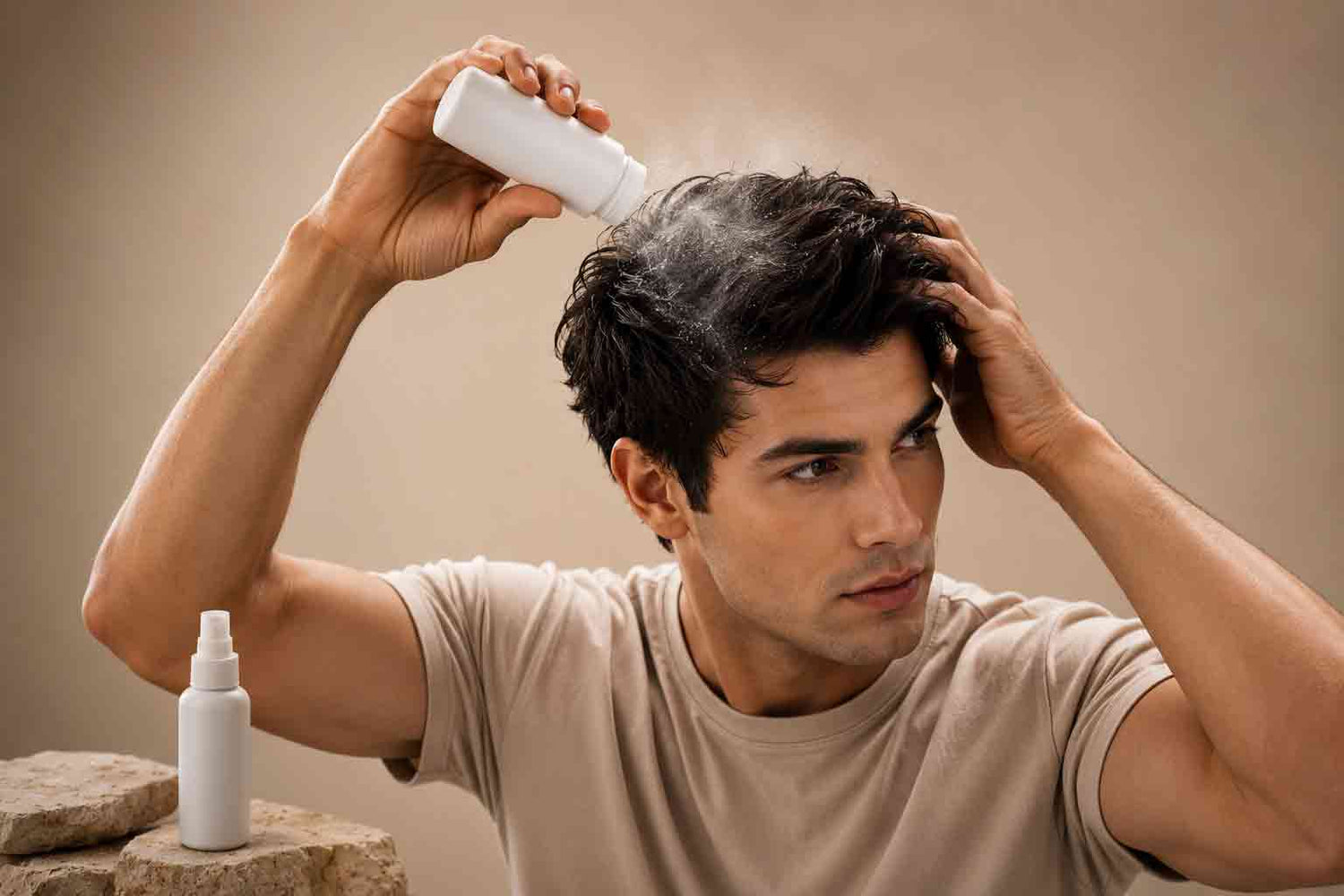
Texture powder is a dry styling product, usually built on a silica base, sometimes blended with cornstarch or rice starch. You shake a small amount onto your fingertips or roots, work it in, and it does two things at once: it soaks up excess oil at the scalp, and it roughens the surface of each strand so hair grips against itself instead of sliding flat.
That's the entire mechanism. There's no chemical bond, no restructuring, no lasting change to the hair shaft. Everything the powder does disappears at your next wash, which is exactly why dermatology sources describe it as a cosmetic styling aid rather than a treatment.
The volume you see is mechanical, not chemical. Oil-absorption plus added friction equals lift at the root and texture through the mid-lengths. That's also why the product behaves differently on fine hair (dramatic lift) versus coarse or curly hair (more grip, less obvious volume).
So, Is Daily Use Actually Bad?
Not inherently. The risk isn't the powder — it's what happens when powder accumulates on the scalp without being removed. A dermatology-focused guide on texture powder and hair loss lays this out clearly: texture powder can still be used on thinning or sensitive scalps, but it's safer applied to the mid-lengths rather than directly onto the scalp, with thorough cleansing after each use and no daily application without that cleansing routine.
The pattern shows up across nearly every source that's looked at this seriously. One hair-education resource puts a number on it: used two to four times a week with a full shampoo wash within one to two days of each use, texture powder isn't inherently damaging — problems start with daily use, inadequate washing, or applying it to a scalp that's already irritated. Multiple independent styling and dermatology sources land on the same 2–4x weekly range, which is a strong signal this isn't just one brand's marketing opinion.
What Actually Goes Wrong With Daily Application
The failure mode is consistent across sources, and it comes down to three overlapping issues:
1. Buildup at the follicle. Texture powder sits on the scalp, absorbing oil and creating volume — and when it accumulates without being washed out, that buildup can clog hair follicles. Clogged follicles don't cause permanent hair loss on their own, but they create the conditions for irritation, which can.
2. Progressive dryness. Silica is doing its job — pulling oil off the scalp — every time you apply it. With very frequent use, that oil absorption can lead to progressive dryness, because you're stripping sebum faster than your scalp naturally replenishes it. Sebum isn't just "grease" — it's part of what keeps the scalp barrier intact.
3. Mechanical stress from removal. This one gets missed. Fallout linked to texture powder is usually traced to buildup that weakens the hair's attachment at the scalp, concentrated application near the roots that leads to crusting, or rough handling during removal — vigorous scrubbing or brushing that pulls hairs already loosened by residue. In other words, the powder rarely damages hair directly. The daily cycle of not-quite-washing-it-out, then scrubbing harder next time to compensate, is what does the damage.
Where the Line Actually Sits
A UK dermatology-guidance piece frames the risk mechanism precisely: persistent scalp inflammation from irritants or unremoved product can push hair follicles prematurely into the resting phase, causing temporary, diffuse shedding known as telogen effluvium, which is typically reversible once the cause is identified and addressed. That's an important distinction — the shedding people worry about from styling powder is almost always temporary and reversible, not permanent follicle damage, and it only shows up under sustained neglect, not from using powder itself.
The same source adds a layering warning worth taking seriously if you're stacking products: combining texture powder with dry shampoo, hairspray, and serums increases total product load on the scalp and can raise the risk of irritation or buildup over time — meaning your "safe" frequency drops if texture powder isn't the only thing you're putting on your scalp that day.
Expert-Recommended Frequency, By Source
| Source | Recommended Frequency | Wash Requirement |
|---|---|---|
| Bolt Pharmacy (UK Dermatology Guidance) | Occasional use; avoid daily | Thorough cleansing after each use |
| Hairfolli Styling Guide | 2–4x per week | Full shampoo within 1–2 days |
| Vagus International | 2–3x per week | Shampoo every 1–2 days if used daily |
| Good Health by Hims | Avoid daily use | Give scalp breaks between uses |
| Ortahaus Reserve | 2–4x per week | Wash within 1–2 days |
The consensus number sits at 2 to 4 applications per week, paired with a wash inside 24–48 hours of each use. Nobody in this space is recommending daily application with infrequent washing — the two variables move together, not independently.
If You're Going to Use It Daily, Here's What Has to Change
Some people genuinely need daily texture — fine hair that goes flat by noon, an active job, a style that collapses without a touch-up. If that's you, daily use is workable, but only if you adjust your washing to match.
Wash on a matching schedule. Research on hair-washing frequency found something relevant here: a large study of over 1,500 participants found that washing five to six times weekly reduced flaking, itch, odor, and oxidative stress markers without harming hair integrity, with higher frequencies producing the highest satisfaction for scalp and hair condition. If you're a daily powder user, your scalp is more likely to tolerate that with a near-daily gentle wash than with two washes a week.
Don't apply directly to an irritated scalp. If your scalp is already tender, flaking, or itchy, skip the powder that day. Powder on top of inflammation is how mild irritation turns into something that takes weeks to calm down.
Use a lighter hand. A little goes further than people expect. Concentrated application at the root — the exact spot most people over-apply — is what creates crusting and clogged follicles fastest.
Rotate in a proper clarifying wash. For people using styling product daily, dermatology-adjacent sources on scalp care recommend a periodic deeper clean layered over regular washing. One clarifying-ingredient guide notes: daily washers should clarify only once every two weeks, since clarifying shampoos, while effective at removing buildup, can be drying with more frequent use — sensitive or treated scalps should limit clarifying washes to roughly once every 7 to 10 days. Translation: your everyday shampoo handles daily residue; a separate clarifying formula handles the deeper buildup weekly-to-biweekly, not every day.
Distinguish your products. Not all "hair powder" is equal, and the ingredient list is where daily-use risk actually starts. Talc-based powders and heavily fragranced formulas carry a different irritation profile than silica- or starch-based mineral powders. If daily use is the plan, the formula matters more than almost anything else on this list.
Ingredients Matter More Than Frequency
This is the part most "is texture powder bad for you" articles skip. Two products both labeled "texture powder" can carry very different daily-use risk depending on what's actually in the jar.
A mineral-based formula built from silica, corn starch, mica, glycerin, and citric acid absorbs oil and adds grip without introducing talc, parabens, or heavy synthetic fillers into daily contact with your scalp. That's a meaningfully different exposure profile than a powder padded out with talc or loaded with fragrance additives, which dermatology literature repeatedly flags as a common sensitizer.
One clinical-facing guide is specific about which ingredients to actually watch for: the most frequent cosmetic sensitisers in hair products include synthetic fragrances, isothiazolinone preservatives such as MI/MCI, and formaldehyde-releasing preservatives — all of which can trigger redness, itching, flaking, and scalp tenderness well before daily use of the powder itself ever becomes the issue. Before you worry about how many days a week you're applying powder, check what's actually in the formula. A clean, mineral-based powder without talc or synthetic fragrance additives changes the entire daily-use risk calculation.
How to Apply Texture Powder So Daily Use Doesn't Backfire
Most of the buildup problem traces back to application technique, not the frequency itself. Two people can use the same powder the same number of times a week and get completely different results depending on how they put it in.
Apply to fingertips first, never straight onto the scalp. Shake a small amount into your palm or onto your fingertips, rub it in slightly, then work it into the roots. Pouring powder directly onto the scalp is how people end up with a concentrated patch that's hard to distribute evenly and even harder to rinse out.
Target the roots and mid-lengths, not a single spot. Distribute in sections rather than dumping it all in one area. Concentrated application in one spot is the single most common cause of the "crusty" texture people report after a few days of daily use.
Use less than you think you need. A few shakes is the standard advice across nearly every source on this topic. If you're using enough that you can see white residue at the part line, you're using too much for daily application.
Apply to fully dry hair. Texture powder is not designed for damp or wet hair. Applying it to hair that isn't fully dry causes clumping, which is harder to work through and harder to wash out completely.
Brush and style before washing, not after. Let the powder do its job for the day. Aggressive brushing right after application, especially near the roots, is one of the mechanical stress points linked to fallout.
Texture Powder vs. Other Daily Styling Products
If daily hold or volume is the goal, it's worth knowing how texture powder compares to the other products people reach for on non-wash days, since some carry a different scalp-contact profile than others.
| Product | How It Works | Daily-Use Risk Profile |
|---|---|---|
| Texture powder | Absorbs oil, adds friction at the root | Low risk with washing every 1–2 days; buildup risk if skipped |
| Dry shampoo | Absorbs oil, often aerosol-based with added starches | Similar buildup risk; can leave more visible residue on darker hair |
| Pomade or wax | Coats the strand with oils or waxes | Doesn't dry out the scalp, but heavier residue is harder to remove without proper shampooing |
| Hairspray | Coats strands with a flexible polymer film | Minimal scalp contact if applied mid-length to ends, lower buildup risk at the root |
| Clay or paste | Coats and molds the strand | Higher residue when combined with texture powder; increases total product load |
Texture powder and dry shampoo function almost identically at the mechanism level — both pull oil off the scalp — which is exactly why layering the two on the same day multiplies buildup risk instead of adding two mild effects together. If you're using texture powder daily, it's worth dropping dry shampoo from the rotation rather than combining both.
Texture Powder and Different Hair Types
Frequency tolerance isn't identical across hair types, and this is where a lot of generic advice falls short.
Fine, straight hair tends to tolerate more frequent powder use because sebum spreads evenly down the shaft and washes out easily. This is also the hair type most likely to actually need daily volume support, since fine hair goes flat fastest.
Coarse or thick hair can handle texture powder well but often needs a firmer scrub at wash time to fully remove it, since the strand's larger surface area holds onto more product per application.
Curly and coily hair carries the highest buildup risk with daily use, for a structural reason: sebum and any applied product distribute poorly along coiled strands compared to straight hair, tending to concentrate near the roots instead of spreading evenly. Combined with the fact that curly and coily hair types are typically washed less often — sometimes just once a week — daily texture powder application on this hair type without a matching increase in wash frequency is the highest-risk combination on this list.
If you have curly or coily hair and want daily texture, the honest trade-off is either washing more frequently than you currently do, or dropping to 2–3 applications a week and using a leave-in or refresh spray on the in-between days instead.
Signs You Should Back Off
Stop and reassess your frequency if you notice any of the following:
- Flaking or visible white residue at the roots that doesn't rinse out easily
- Scalp tenderness, tightness, or a "crusty" feeling by the end of the day
- Increased shedding when you brush or run your fingers through your hair
- Persistent itching that doesn't resolve with your normal wash
- Dryness or breakage concentrated at the roots specifically
None of these are permanent on their own. Scalp shedding tied to irritation is typically reversible once the underlying cause is identified and removed — but the fix is simple: drop back to 2–3 uses a week, add a clarifying wash, and give your scalp a few days to reset before resuming your normal routine.
Choosing a Formula Built for Frequent Use
If daily or near-daily use is realistically part of your routine, the formula you pick matters more than any technique adjustment on this list. A few things worth checking before you commit to using something every day:
Ingredient transparency. A full ingredient list should be visible on the packaging or product page, not just a marketing phrase like "natural formula." Silica, corn starch, mica, glycerin, and citric acid are common in mineral-based powders and are well understood at the ingredient level. If a brand won't list what's actually in the jar, that's a reason to be cautious about daily contact with your scalp.
No talc. Talc has a well-documented irritation and safety history that's kept it out of most modern mineral-based powder formulas. A cornstarch or silica base achieves the same oil-absorbing, volumizing effect without it.
Realistic regulatory claims. In the US, cosmetic hair products are not "FDA approved" — that phrase doesn't apply to this product category, and any brand claiming it is misrepresenting how cosmetic regulation actually works. What a legitimate cosmetic brand can accurately say is that its products are listed under FDA's Cosmetic Product Listing requirements as established by MoCRA (the Modernization of Cosmetics Regulation Act). That's a real, verifiable claim. "FDA approved" is not.
Fragrance load. Since synthetic fragrance is one of the most common triggers for scalp sensitization, a lighter or more minimal fragrance profile is generally the safer choice for a product going on your scalp every day, versus one you use twice a week.
None of this replaces the washing routine covered above — a clean formula still builds up if you never wash it out. But starting with a formula that's transparent about what's in it, skips talc, and doesn't overload on fragrance gives you more room for frequent use before buildup becomes a scalp issue.
Frequently Asked Questions
Can I use texture powder every day?
Yes, if you wash it out daily or near-daily with a gentle shampoo and avoid applying it directly onto an already irritated scalp. Without that washing discipline, daily use raises the risk of buildup, dryness, and follicle clogging.
Does texture powder cause hair loss?
Not directly. Texture powder doesn't chemically alter or damage the hair shaft. What can contribute to shedding is unremoved buildup that irritates the scalp, or aggressive brushing and scrubbing used to remove crusted residue.
How often should I wash my hair if I use texture powder daily?
Aim to wash within 24 to 48 hours of each application at minimum. Daily powder users generally do best with near-daily gentle washing, plus a dedicated clarifying wash roughly every one to two weeks to catch buildup a regular shampoo misses.
Is texture powder bad for thinning hair? It can be used on thinning hair, but apply it to the mid-lengths rather than directly on the scalp, use a lighter amount, and cleanse thoroughly after each use.
What ingredients should I avoid in a texture powder if I plan to use it often?
Watch for talc, synthetic fragrance blends, and preservatives like MI/MCI, which are among the most common scalp sensitizers in hair products. A mineral-based formula using silica, corn starch, and mica carries a lower irritation profile for frequent use.
Can texture powder clog pores on the scalp?
Yes, if it isn't washed out consistently. The powder itself sits on the surface and doesn't penetrate the follicle, but layered, unremoved residue can build up around the follicle opening and contribute to irritation.
Is texture powder safe to use with dry shampoo on the same day?
It's better to pick one or the other. Both products work by absorbing scalp oil, so combining them on the same day increases total product load and buildup risk without adding much extra benefit.
Does curly or coily hair need a different texture powder routine than straight hair?
Yes. Product tends to concentrate near the roots rather than spread evenly along coiled strands, and curly and coily hair is typically washed less often. That combination makes daily use riskier for this hair type unless wash frequency increases to match.
Sources
- Bolt Pharmacy — Can Texture Powder Cause Hair Loss? UK Dermatology Guidance
- Hairfolli — Hair Texture Powder: What It Is, How It Works and Is It Safe
- Vagus International — Does Texture Powder Cause Hair Loss? Myths, Evidence & Healthy Use
- Good Health by Hims — Does Texture Powder Cause Hair Loss? What You Need to Know
- Ortahaus Reserve — Is Styling Powder Bad for Hair? What You Should Know
- The Better Scalp Company — Clarifying Surfactants and Chelating Agents
- AcademicJobs — How Often to Wash Hair: What Dermatologists Say
- TikTok Discover — Is It Bad If I Use Texture Powder on My Hair Every Day
This article is for general educational purposes and does not replace individualized advice from a board-certified dermatologist. If you experience persistent scalp irritation, flaking, or shedding, consult a dermatologist.

Leave a comment
This site is protected by hCaptcha and the hCaptcha Privacy Policy and Terms of Service apply.